Flatbed Towing in Queens, NY
All four wheels off the ground. The only safe way to move an AWD crossover, an EV, a lowered car, a classic, or a damaged vehicle. Soft straps over the tires, low-angle ramps for splitters, no chains across paint.
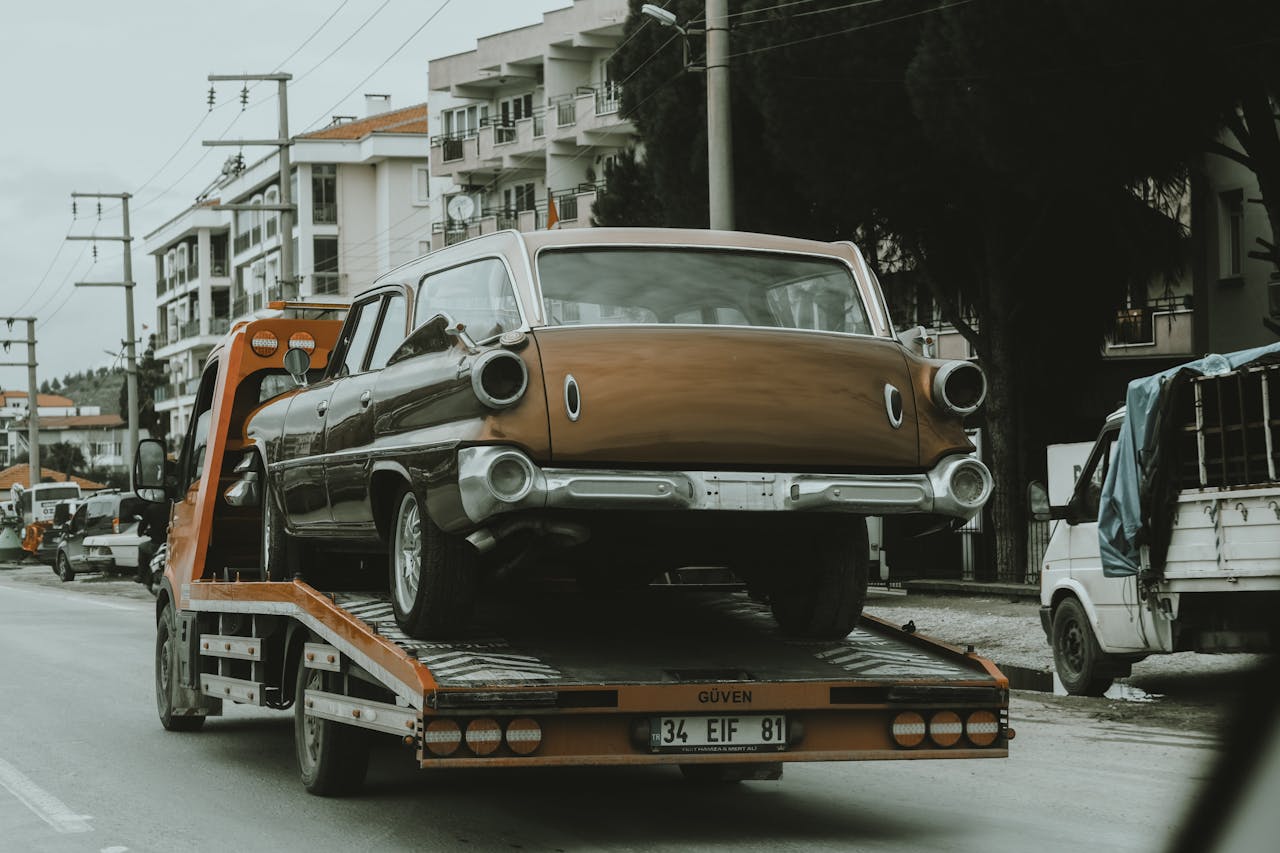
When you actually need a flatbed
Wheel-lift towing — the kind where the front (or rear) wheels are lifted by a yoke and the other two wheels roll on the road — is fine for a regular front-wheel-drive sedan or a rear-wheel-drive vehicle whose drive wheels are lifted. It's faster to hook, takes less space at pickup, and costs less. The trouble starts the moment the vehicle has any of the following: all-wheel-drive, electric drivetrain, lowered ride height, locked or damaged wheels, or significant value where a single drivetrain repair exceeds the price difference between a wheel-lift and a flatbed many times over.
The list of cars that need a flatbed in 2026 is much longer than most drivers realize. Roughly 60% of new vehicles sold in the New York metro area are AWD — every Subaru, every Audi quattro, almost every BMW xDrive, every Acura SH-AWD, the AWD versions of CR-V, RAV4, Rogue, Forester, X1, Q3, Tiguan, every Range Rover, Macan, Cayenne. If you bought it in the last decade and there's a hint of "AWD," "4MOTION," "quattro," "xDrive," or "Symmetrical AWD" on the badge, the answer is flatbed.
What it costs
Flatbed service inside Queens starts at $95 hookup plus $4 per loaded mile. Loaded miles are counted from your pickup location to your destination — not the truck's drive to you. A typical Forest Hills to Astoria flatbed (about 6 miles) runs $119 total. Forest Hills to Bayside (12 miles) runs $143. Forest Hills to a JFK area body shop (8 miles) runs $127.
The price is firm before the truck rolls. The driver does not show up and add an "EV surcharge" or a "low car difficulty fee" — none of those exist on our pricing. The only legitimate change-on-arrival is if the vehicle turns out heavier than dispatched (a customer who said "SUV" but it's actually a 13,000 lb F-450) and a heavy-duty truck has to be sent instead. In that case the original truck leaves, no charge, and the new dispatch is quoted fresh.
Why wheel-lift on AWD destroys the drivetrain
An all-wheel-drive system is engineered around the assumption that all four wheels rotate at the same speed (with small differences allowed by the center differential or viscous coupling for cornering). Lifting the front wheels and rolling on the rear means the rear wheels spin at road speed while the front wheels are stationary. The center differential or coupling tries to compensate for that mismatch the entire trip — across Queens Blvd, down the LIE service road, into the body shop. The result is shredded clutch packs in the center diff, a burned viscous coupling, or a transfer case full of metal shavings.
Subaru's repair tickets for a destroyed center diff start around $2,800. Audi quattro transfer cases run $4,000 to $7,000 with labor. Acura SH-AWD rear differentials are $3,500 plus. The cost difference between wheel-lift ($75 hookup) and flatbed ($95 hookup) is $20. Every reputable operator quotes flatbed for AWD without asking — the operators who quote a wheel-lift on an AWD are either uninformed or counting on the damage being someone else's problem.
Tesla and EV specifics
Tesla's service manual is explicit: every Model S, Model 3, Model X, Model Y, and Cybertruck must be flatbedded. The motor is hard-coupled to the wheels with no clutch and no transmission neutral that disengages — rolling on the rear wheels (or front in dual-motor cars) back-feeds the motor and can damage the high-voltage inverter. The same is true for nearly every modern EV: Rivian R1S/R1T, Lucid Air, Ford F-150 Lightning, Mustang Mach-E, Chevy Bolt, GMC Hummer EV, Hyundai Ioniq 5/6, Kia EV6/EV9, VW ID.4, Polestar 2, and Volvo XC40 Recharge. We carry the Tesla-recommended tow chocks (front-wheel chocks that prevent rolling during loading on the bed) and use the manufacturer-specified tie-down points.
Lowered cars and splitters
The standard flatbed approach angle is about 14 degrees when the bed is fully extended. That clears most stock vehicles fine. For lowered cars — anything on coilovers, air suspension dropped, factory-lowered M3/M5/AMG/STI/Type R, or aftermarket splitters and side skirts — we use low-angle aluminum extension ramps that bring the angle down to roughly 8 degrees. For extreme cases (Liberty Walk, RWB Porsches, very low static drops) we add 2x6 wood planks to bridge the angle break at the road. The driver walks the underbody before committing to load.
Vehicle types we routinely flatbed
- AWD crossovers and SUVs: CR-V AWD, RAV4 AWD, Rogue AWD, Forester, Outback, Crosstrek, X3, X5, Q5, GLC, Tiguan, Atlas, Range Rover Velar/Sport/Full, Macan, Cayenne, Wrangler 4xe.
- EVs: All Tesla models, Rivian, Lucid, Lightning, Mach-E, Bolt, Ioniq 5/6, EV6, EV9, ID.4, Polestar, XC40 Recharge, BZ4X, Solterra.
- Lowered and exotic: M-cars, AMG, Type R, STI, Civic Si on drops, 911s with PASM down, Cayman, F-Type, Corvette C7/C8, Ferrari, Lamborghini, McLaren, Aston Martin.
- Classics: Pre-1980 American iron, vintage European, JDM imports, anything with thin original sheet metal that shouldn't see chains.
- Motorcycles and scooters: Sport bikes, cruisers, touring bikes, dual-sport, scooters, mopeds, electric bikes.
- Damaged vehicles: Anything with locked wheels, broken suspension, missing wheels, on its side or roof, or with non-functioning steering.
Common Queens flatbed scenarios
Audi or BMW dead in a Forest Hills driveway
Common combination — German AWD vehicle that won't start in cold weather. The driver wants the cheap quote but the right call is a flatbed every time. We've seen Audi A4 quattros wheel-lift towed by another operator end up with $5,200 in transfer-case work. The owner sued the tow company and lost because the work order didn't specify flatbed. Pay the extra $20 upfront.
Tesla on Queens Blvd with a flat
You can't change a Model 3 tire on Queens Blvd safely (active traffic, narrow shoulder), and even if you could, Tesla's flat-changing process requires a specific jack pad on the lift point or you crack the underbody battery cover. Flatbed tow to a tire shop, ride home or to work, pick the car up after. We tow plenty of Teslas to the Tesla service center on Northern Blvd in Flushing for tire-related work that the mobile ranger can't handle on the side of the road.
Lowered Civic Si stranded in Glendale
Tuner cars on Metropolitan Ave near Cooper Ave at night — daily occurrence. Modified intake or fuel system fails, car won't restart, owner is panicking that the wrong tow truck will rip the splitter off. The flatbed pulls up, the driver inspects the front lip, drops the low-angle ramps, slides the wood planks under the splitter side, and walks the car up at idle pace. Splitter intact, paint untouched.
Classic Mustang or Camaro on Atlantic Ave
Older cars without proper tow hooks need careful tie-down. Soft straps loop over each tire — never around a leaf spring, exhaust, or original chrome. The driver photographs every body panel before loading so condition is documented if there's any dispute later. Classics typically go to Brooklyn or Long Island specialty shops; we handle the pickup and the long-distance leg.
What to do before the flatbed arrives
- Tell dispatch the actual vehicle. "AWD" matters. "Lowered" matters. "EV" matters. The right truck is dispatched only if the right info is on the call.
- If the car is in a tight spot, describe it. Underground garage, narrow alley, low ceiling — flatbeds need overhead clearance and turning room. Sometimes a wheel-lift is the only truck that fits, even if a flatbed would be ideal — we'll tell you on the call.
- Note any aftermarket parts. Front splitter, side skirts, lowered ride, wide-body fenders, custom wheels — the driver needs to know to bring the low-angle ramps and wood.
- For EVs, note the state of charge. A Tesla at 0% can't be put in transport mode and needs to be loaded with the parking brake released manually — which the driver does, but it changes the loading procedure.
- Photograph your vehicle's existing condition. Phone photos of all four corners, panels, and wheels before the truck arrives. Standard practice for any tow on a high-value or modified vehicle.
Why our flatbed rate isn't the cheapest in Queens
You'll see flatbed quotes online as low as $65. The math doesn't work. A flatbed truck costs $95,000 to $130,000 new, insurance runs $1,200 to $1,800 per month per truck in NYC, fuel for a diesel medium-duty is $90 to $140 per shift, and a qualified operator earns $28 to $40 per hour. A $65 flatbed quote means one of three things: the operator is uninsured and you have no recourse if your $80,000 X5 ends up scratched, the quote climbs to $185 once your car is on the deck, or the driver shows up in a wheel-lift and tries to convince you it's "basically the same thing." None of those outcomes is good at midnight on Queens Blvd.
Flatbed Towing Questions
Why does an AWD vehicle need a flatbed?
All-wheel-drive systems use a center differential, transfer case, or viscous coupling that expects all four wheels to rotate at the same speed. Wheel-lift towing leaves two wheels rolling on the road and two off the ground — that mismatch can shred the center diff, burn out a viscous coupling, or destroy the transfer case. The repair on a Subaru, Audi, or modern CR-V is $2,500 to $7,000. A flatbed costs an extra $20.
Can my Tesla be wheel-lift towed?
No. Every Tesla — Model S, 3, X, Y, and Cybertruck — is flatbed-only per Tesla's own service manual. The motors are mechanically connected to the wheels with no neutral that disengages them; rolling on the rear wheels back-feeds the motor and can damage the inverter. Same goes for most other EVs.
How do you load a lowered car without scraping?
We carry low-angle aluminum extension ramps that drop the bed angle from the standard 14 degrees down to about 8 degrees. For very low cars we also carry 2x6 wood planks to bridge the angle break. The driver checks splitter clearance before committing to load.
Can you secure a classic without chains across the body?
Yes. Soft tire straps (basket-style polyester webbing) loop over each tire and tie down to the bed at four corners. Nothing touches paint, chrome, or trim. Older cars without modern tow hooks are tied at the wheels exclusively — never around suspension components, exhaust, or fuel lines.
What about a motorcycle on a flatbed?
Bikes ride on a separate wheel chock bolted to the bed, with four soft straps — two over the lower triple clamp and two on the rear subframe or passenger pegs. We never run a strap through the frame or over the seat.
Is a flatbed required for a damaged vehicle?
Almost always. Locked wheels, broken suspension, a flat tire that can't be changed safely, missing wheels, or a vehicle on its side or roof — all require flatbed. Wheel-lift only works when the non-driven wheels can roll and steer freely.
How heavy a vehicle can you flatbed?
Our standard medium-duty flatbed handles vehicles up to 10,000 lb GVWR — that covers every passenger car, SUV, and most full-size pickups. For F-450, F-550, Sprinter dual-axle vans, box trucks, or anything 14,000 lb and up, we dispatch a heavy-duty rotator.
Will the flatbed scratch my paint?
Loaded properly, no. Tires are the only contact point with the bed. Soft straps stay clear of body panels. The only common damage source is splitter or rocker contact during loading on a steep angle — preventable with low-angle ramps and a careful driver.
Other Services
24 Hour Emergency Towing
Round-the-clock dispatch from Forest Hills. From $75.
Motorcycle Towing
Wheel chock + 4 soft straps. Sport, cruiser, scooter, electric. From $110.
Long Distance Towing
NY/NJ/CT/PA legs, hookup waived 50+ mi. $4/mile.
Accident Recovery
Post-NYPD scene clearance, condition photos, insurance billing. From $125.
Battery Jumpstart
2,000-amp packs, alternator check before you drive off. $50 flat.
Roadside Assistance
Jump, lockout, tire, fuel under one umbrella. Per service.